Headless · on events
Attached to an event
Fire an agent on a table insert, an inbound API call or a schedule. You supply an initial prompt built from the triggering row, and the agent runs on its own.
Platform · AI copilot, agents & workflows
Saltcorn gives generative AI a structured environment to work in. Build with AI, and build AI applications on top of your data — without giving up control.
The copilot is itself a Saltcorn agent, assembled from skills that build the application's own parts — tables, views, pages, actions and workflows — and write React and JavaScript snippets from plain-language prompts.
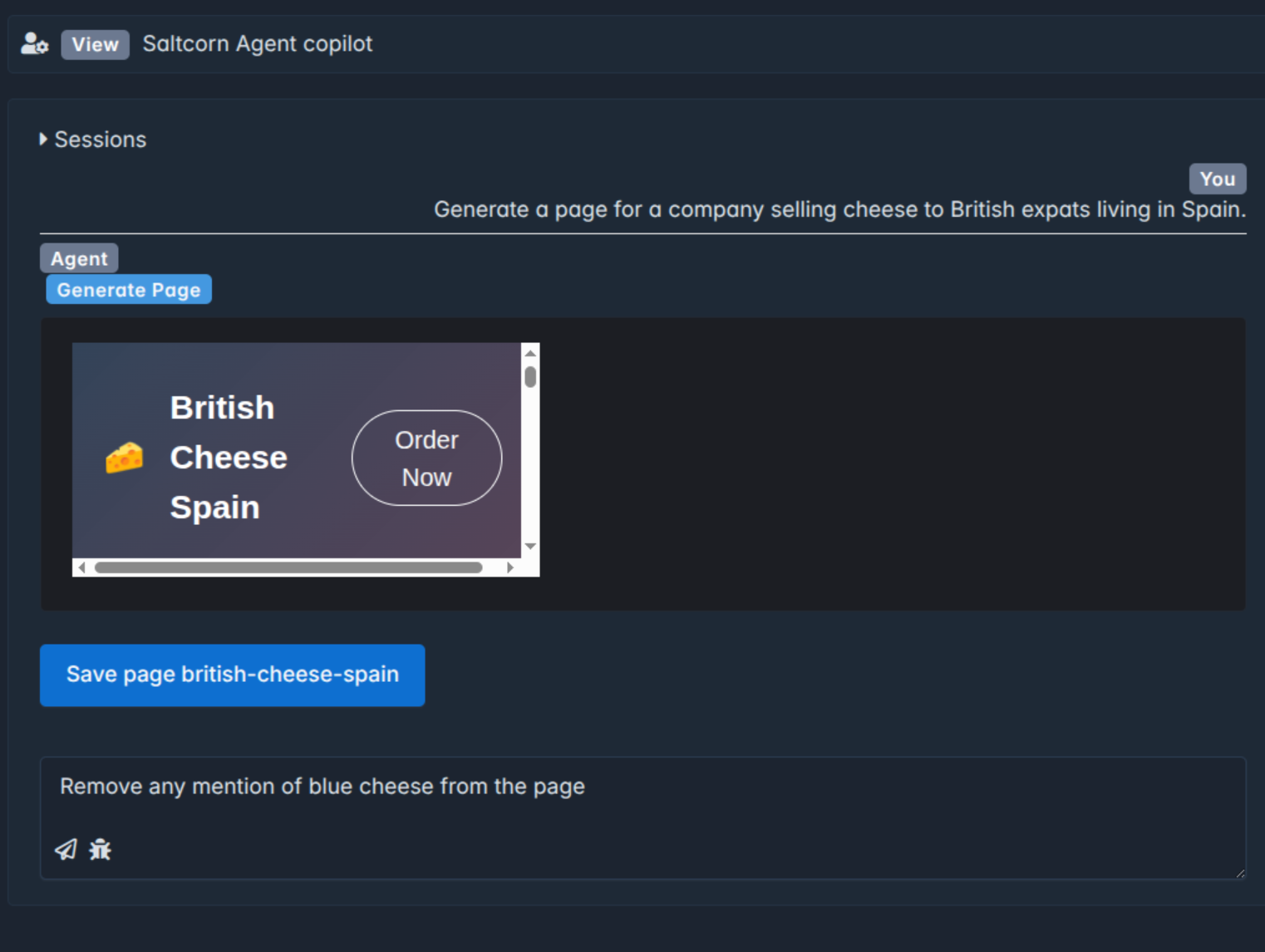
Type what you want — "generate a page for a company selling cheese to British expats in Spain" — watch it render, then refine it conversationally: "remove any mention of blue cheese." Good for getting an application off the ground, and for accelerating the everyday changes.
The same copilot agent drives two interfaces: this quick chat, and the App Constructor for planning and building larger applications end to end.
Drop generative AI into a deterministic, durable workflow — generate text, an image or structured JSON at a chosen point, with everything around it (loops, conditionals, forms, database writes) under your control.
Because each run is persisted with its context, an AI step can pause for human input and resume later — surviving beyond a single request. And since Saltcorn 1.4 the server can stream LLM output to the user token by token, over the same websocket that powers real-time collaboration.
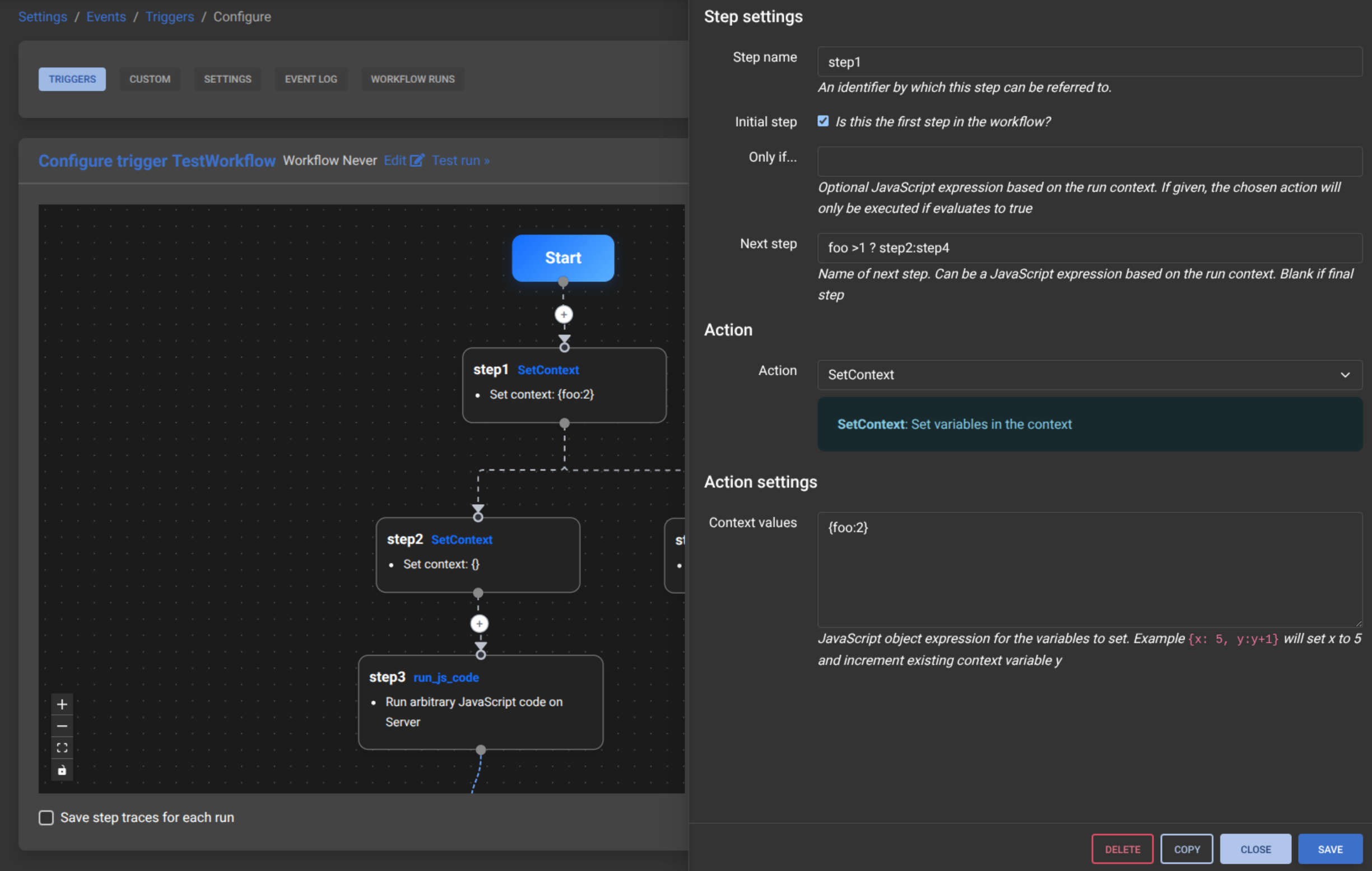
next_step formulas, and a per-step configuration panel. The AI step lives in an inspectable flow, not a black box.Generative AI is powerful, but unbounded. Saltcorn gives it walls to push against — a schema, roles, actions and audit — so what it produces is something you can actually run.
Every table, view and page carries its own minimum role; every action is logged; every workflow run is durable and resumable. An agent operating inside that structure inherits its guardrails — reading only the rows a user may see, writing only through actions you defined, leaving a trail behind it.
Structured, not sandboxed away The database is the ground truth the model works againstWhen the execution path should be decided by the model, build an agent. An agent's behaviour is defined by the set of skills you enable — most add a tool to the inference loop; others shape the chat.
Fire an agent on a table insert, an inbound API call or a schedule. You supply an initial prompt built from the triggering row, and the agent runs on its own.
Build a view on the Agent chat pattern for a ChatGPT-style interface — past chats listed on the left, and conversations shareable with other users. Voice in and out via ElevenLabs and device voice input.
Ground agents and workflows in your own content, and interoperate with the Model Context Protocol in both directions.
Pull documents into agents and workflows through vector or full-text search, so answers are grounded in your data instead of the model's guesswork.
Publish your tables and actions as an MCP server, so other AI tools can read and act on your application through a standard protocol.
Point a Saltcorn agent at an external MCP server with the MCP skill, and its tools become part of your agent's repertoire.
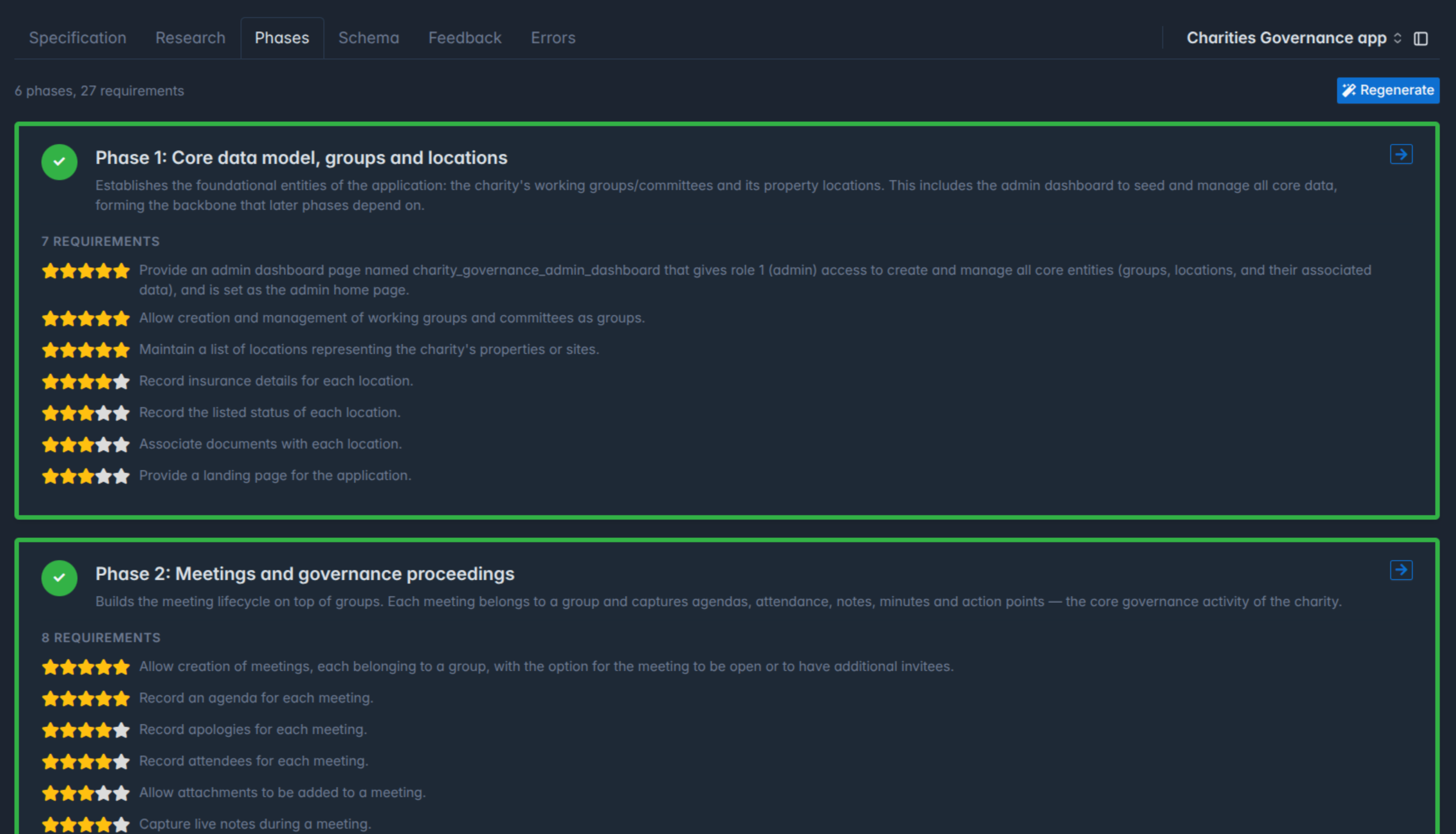
For larger applications, the App Constructor drives the copilot agent through the way software is normally built — describe, clarify, research, then plan a build as phases of ordered tasks and work through them, with a human in the loop at every stage.
Requirements are scored 1–5 by importance and are yours to edit; tasks are ordered by dependency and by entity type, so tables get built before the views that depend on them. Run one task or a whole phase, test, and the next phase adapts to your feedback. It can even self-heal — responding to a runtime error and fixing the build itself.
Run classical machine learning directly on table data, with results stored as fields the rest of the application can use — in views, workflows and actions.
Fit a continuous outcome from the fields you already hold — a price, a score, an estimate — and write the prediction back to the row.
Assign each row to a class — a risk band, a segment, a triage bucket — as a stored field available everywhere else.
Analyse trends over time to forecast what comes next, and surface the result on the same dashboards as your live data.
Spin up Saltcorn and let the copilot draft your first app — free, open-source, on top of a real database you control.
The Saltcorn team can design the agents, copilot skills and AI workflows your application needs.